P. J. O'Rourke
Tuesday, March 10th, 2026 00:00![[syndicated profile]](https://www.dreamwidth.org/img/silk/identity/feed.png) quoteoftheday_feed
quoteoftheday_feed"Very little is known of the Canadian country since it is rarely visited by anyone but the Queen and illiterate sport fishermen."
quoteoftheday_feedquoteoftheday_feedquoteoftheday_feedquoteoftheday_feedarablit_feed

Between Iman Humaydan, Michelle Hartman, and Emma Hardy
Iman Humaydan is a Lebanese novelist, researcher, and academic whose latest novel Songs for Darkness — published today in Michelle Hartman’s English translation– depicts the lives of four generations of women and their experiences of love, sacrifice, revolution, and grief in the fictional village of Ksoura in Mount Lebanon. Set against the backdrop of the massive changes of the 20th century, the novel takes the reader from the first World War to the Israeli Invasion of 1982, intertwining the story of these women with the story of the formation of modern Lebanon. Throughout the novel, Iman draws her reader in an intimate relationship with her characters, letting you share in their most raw and vulnerable moments.
Michelle Hartman’s translation was clearly born of a deep love and respect for Iman’s work, and the two have worked together on several books and have grown to understand one another in a way that can only be described as an ideal writer-translator collaboration.
Iman will be traveling to meet with readers in the United States in April and plans to make stops in San Francisco, Massachusetts, and New York, and we also have a short excerpt today from the novel. The conversation has been lightly edited for clarity.
Can you start out by telling us about your inspiration and or motivation for writing this book?
Iman Humaydan: This book, for me, is a continuation of what I have started since B as in Beirut. I work always with more or less marginalized women. With the first book, they [the characters] were in a closed area, which is the building. The second book was in a village; I just took the personalities out of four walls, until I arrived at 50 Grams of Paradise and then Songs for Darkness. If I want to imagine the movement of these characters, it was just to go outside and find their place outside the private. And in Songs for Darkness, I tried to give, totally, the talking over to them, for them to tell the story, not me to tell their story. I was very concerned about connecting these characters and their lives within a social and political context, and a historical one. That is why I wrote this book. My characters are there; they are related to what’s going on out in the country and they are a part of this history. That was my main concern in this book, to create this relationship between their lives and the life of Lebanon.
You develop these beautiful characters that as a reader I easily fell in love with and felt a strong emotional connection with which really emphasized the heartbreak of their suffering and challenges. Could you talk about your writing process, and how you developed these characters?
IH: Always, in my mind, there was this very important idea that these characters should be linked to what’s going on outside. All their lives, from Shahira til Asmahan, their reactions, their movement in the universe of the novel, their ideas were very intimately connected to the social, political and to the historical context. So they were not people that do not have a relationship with what is going on outside, and this was my main important point.
When I talk about Shahira, who was born at the end of the 19th century, like 1890, I should put Shahira’s life within this context, and the same as her daughter Yasmine and her grandchild Layla and then the great-grandchild Asmahan. It was important for me to give the voice for each character in a very logical and believed context. I mean Shahira cannot say words that Asmahan said, and cannot have the same approach as Asmahan had.
The thing that differs between the characters — I think Shahira was a remarkable person because she was the column of the female experience, she was the cornerstone of these [characters’]experiences, they went different directions, but she was the source. And this is something very dear to my heart, always in my mind I have a female character which is the source. Although in my life I never had a female character who was a source for me. Neither my grandmother nor my mother because they were very silent people, and maybe this silence provoked, or evoked a lot of curiosity and need for me to let women speak.
In the book we see these major political moments and movements of Lebanese history act as a catalyst for a lot of what these characters go through and how their stories are shaped. Why did you choose to set the story during this particular era of history?
IH: Because the 20th century witnessed, first of all, two world wars, both affected Lebanon. And there were also the independence movements in the Arab world, the pan-Arab movement, the declarations of nation states, the internal problems in each country because the states were in a state of being formed. So this was a very rich century, and it was a century with the failing experiences of building a nation state. Also, I shouldn’t forget it was the century where Israel was declared as a state, with all the consequences of declaring Israel as a state. If you look at our history since the 1940s, we didn’t have a decade without big problems in the Arab world. I wanted to look back at this history and see the place of women, where it was. And the place of women means, between brackets, the place of all people who didn’t have a voice. Not only women, but other communities.
Also, it was a near history for me. I heard a lot from my father, I heard a lot from other people, so it is a place where I can, in my imagination, grab and do something about it. It would be much more difficult for me to work on the 19th century, let’s say, on the fall of the Ottoman Empire at the end of the 19th century before the first World War and how our communities in Mount Lebanon dealt. So I chose something that affects me, affects my mother and my grandmother, and I worked on it.
In the translator’s note, Michelle, you wrote that Iman described the book as being “by, of, and for women.” What does it mean that you’re both female artists writing or translating these really powerful female stories?
Michelle Hartman: I think Iman answered this in a way, talking about her interest in connecting the lives of women throughout a historical period to their contexts and to the specific things that were happening and the ways in which people, in this case women, are impacting the world around them and the way that the world around them is impacting them. I think one of the things that I really love about Songs for Darkness — and this is sort of a characteristic of Iman’s work in general, but you really see it come out in Songs for Darkness because it’s a big story and it moves over a big period of time — is that there are lots of characters, and there are lots of main characters. Shahira in a way carries through because she is this grandmother figure, but the other female characters that come out and narrate stories are also really important characters, not side characters. And I think that one of the things that is so important here is the way in which the stories are very detailed, and the stories are very real. The stories connect very deeply to the histories and politics, as Iman just said, but they aren’t, if I can say this, obvious, they are not cliché. We don’t actually know what’s going to happen exactly, and the characters are all acting internally from their perspective as people.
So this is something that’s really remarkable about this particular novel, and I think as a translator and as a woman translator I really love this characteristic of the novel. It doesn’t necessarily make it easier to do it, but it makes it very interesting and it makes it very compelling to try to figure out how to convey that across the languages. That’s the job of the translator, to read it, understand it, and get really immersed in it. Then you have to figure out how to make that, which in its own context is very rich and deep and nuanced, move and actually work in a whole other language context. So that’s actually something I think that we can say, specifically about Songs for Darkness, which was really interesting to work on.

IH: I want to add that I am so grateful to have Michelle as a translator of my novels into English because it is a really wonderful experience. There is a lot of understanding between us, and I think this is due to the love that Michelle has for the Arabic language and for the Arabic culture, and this helps a lot. I mean the worst thing might happen if a translator is translating because he or she “works as a translator” full stop. With Michelle, translation becomes a life between us, and I am happy to be working with her, really.
MH: Well we have worked together for a while, and so I think that we also have developed that relationship over a time. We’ve spent a lot of time together, and hung out together, and talked; it does help to be able to feel what’s going on when you really know a lot about how somebody thinks and how they talk and how they do things, and where they are coming from. The more understanding you have the more you can bring that into the text.
IH: And it helps you knowing the Lebanese society.
MH: Yes, yes right.
IH: I don’t know, really; I wonder if you translate let’s say an Algerian novel, would it be the same for you? This is a question outside the question.

MH: I haven’t really embarked on that kind of a project and I think, for me, I feel like — not that it’s impossible someday — but that I work on things that I have some connection to or some feeling for. I don’t just translate whatever comes across. I work on things that I feel like I can do a good job on and that I can understand in some way, [that] there is some kind of important connection or something that I really want to do. Obviously Iman‘s work I really love and I really connected to from the first work that we did together. And so now, even more, I feel like I’m a part of the world of these books. I know this world really well. The real world, of course, because of going to Lebanon a lot and spending a lot of time in that context, but also the fictional world. I feel I know that fictional world really well and it’s connected to the real world. I feel really grateful that I get to do them because the new work comes out and I’m so excited to kind of get all into it. And I think that it’s that kind of spark and that kind of interest and connection that makes it work.
IH: Also I want to add one point, that Michelle respects the choice of the writer when we come to the last draft. Every time we read it together and always Michelle puts a circle around certain words that she’s hesitant about, either this word or that word. And I really admire that she respects what the writer feels about which word might fit. Of course I always leave it to her, because she is the one who knows English, who can really choose the right word that resonates with the original language. And this is something that you don’t find a lot with other translators. My books have been translated into many languages and I have a very special experience in the translation into English with Michelle.
Michelle, could you talk a little more about your translation process?
MH: I think one thing that I love about working on Iman’s fiction is that, as you can tell from talking to her, there is a whole world that exists and the book is part of it. There’s a much bigger world that she’s created that is not necessarily in the pages, and the pages are what she’s chosen to create for us to see, and in a very conscious way. I mean that might sound obvious, right, that’s partly the process of fiction, but in Iman’s case it’s a very big and very well developed universe that she has created. In working in her text, you are really immersing yourself in a world. So that was a really interesting part of the book, because also it’s so big. It’s much bigger in scope than the other novels by Iman because it’s over such a long period of time. It ends in 1982 with the Israeli invasion and you know that there’s more (what’s happening now, where is Lama, where is Asmahan), and there is that kind of suspended ending. So because of all of this, and because the novel is pretty long, I also had to think about and imagine translating something to make that apparent inside of the text. And these are intangibles, these are not the word to word to word parts of translation; this is the bigger picture of translation. There was this element of working on the book, which I think was really interesting and challenging.
And then also another part of it that I really liked and was interesting for me, as someone who’s worked on and studied Lebanon a lot, is the history of this region and the events that are so much a part of the text. It’s much more obvious, if I can put it like that, in the text that it’s taking place over this historical period and also trying to engage some of those really key events and moments in the history of the region and the modern state. And I do that work as a professor, I do it with my students, I do it in my other research. I had recently finished working on oral histories of the Lebanese Civil War and women’s lives in the civil war with a colleague of mine. I was doing all of this just as I started delving into the text, and all of that came into play. So I think that’s another really interesting part of translating it and I think that that will be interesting for the reader.

This text is just so character-based, I mean I think the reason you turn the pages is because of the characters; you turn the pages because you want to really know what’s going to happen in the story. At the same time, there is this big history that’s being told and you really learn a lot from that. And I know Iman did a lot of research on it to make that come to life. So I, as a translator, went back and read histories and read other texts that also talked about these times because I wanted to try to do that same thing–of capturing the right way of talking and the words and the tone in English to make those different parts come to life in the right way. So that’s part of the process of it.
IH: You’ve reminded me of the research I did before writing this novel. I will give two very tiny examples: The example of taking the train to Palestine from Lebanon that Ghassan, the husband of Yasmine, did because he worked in Haifa in Palestine at that time. And the second example was the film that Layla saw the night of her disappearance. And these two very mild, very secondary incidents events that happened in the novel took me I don’t know how many weeks to find; because to find out on the 30th of April 1963 what film was playing in Beirut, in downtown Beirut, I contacted maybe 10 people who are related to cinema and most of them didn’t know. And the second one, the train, you know that the civil war in Lebanon really caused a very dangerous cut of our memory. We don’t have archives of how the trains changed directions after the declaration of Israel because the trains couldn’t go anymore to Palestine. For example, we have a directory of trains in Lebanon, but we don’t have trains. So, when you ask how the train used to move, it’s difficult to find people to answer you. The same as the women’s protest in downtown Beirut, because there is no documentation of this unless we go to people like Michelle, and other researchers who worked really deeply on Lebanese history and the modern history of Lebanon. So, it was so interesting this trip that I took to find out all this tiny information and put them together while building the novel.
MH: So it’s fictional of course, but the documentation of the history that’s inside of this fictional text offers us a lot, and it offers it to the younger generations, and for all of us, to learn or to remember these things. The sections in Palestine, reading them today with everything that’s happening in Palestine now with the genocide and the occupation, and then reading these historical moments and remembering in the textual form, remembering how people were able to move back and forth, remembering this is part of one culture or community, you would have a job here you would have a job there, people intermarried, people moved back and forth over the borders. And we know this, but here we see this documented in a particular way. So there are so many moments in the text that are tiny, but they give this importance to contemporary history as well as older history. And these are just one or two examples, but there’s so many of these throughout the novel that are really crucial.
IH: These historical details helped in constructing the historical background — but it’s a novel, it’s always a novel. It’s always a fiction. Although I borrowed history, it’s not a historical novel.
We see the songs and the poetry play different roles throughout the novel. As a way for the characters to express themselves, a way for them to escape their reality. I also found that, when I saw singing or poetry come up, it was a moment where a character needed to go into her inner self and reconnect with herself. If you could talk a bit about the songs, from your point of view, and the role that they play in the book.

IH: The songs came into the book in a very spontaneous way. I cannot tell you that I was thinking of them at the beginning of my writing, but when creating the character of Shahira — and not forgetting the social context of where she was and the history, the beginning of the 20th century — the songs came in a very harmonious way, when I was reading about the economic life in the Beqaa part of Lebanon, because Shahira came from the South Western part of Lebanon. And there, people used to live on planting wheat and other cereals, and I did some research there with old people, and they told me that women used to go down to the field and they used to sing. And there were special songs for the harvest and for the planting of the wheat, and this stuck in my mind, and I started searching for these kinds of songs. I found out also a very interesting thing: that the songs of the western Beqaa Valley are almost the same as in Soueida. Soueida is the Druze area in Syria, and in the western Beqaa there are three or four Druze villages. So I said okay, why not, the songs also travel as people travel.
I used these songs in the novel to show them as a part of their daily life and a part of resistance for them. They resisted through songs. It was their way of expression at that time, maybe it was difficult to express definitely, and it gave them a lot of self peace and internal peace. And there is a sentence that Shahira always used in her life, she says she cheats, I don’t know if I can use the word cheats, maybe you tell me how you translated it Michelle, تحتال على قدر, she cheats on fate, or on destiny. I used the word تحتال على قدر, always she deals with her destiny, with her faith, with intelligence and will and a strong personality, that she does not want to be defeated by fate and songs were a part of this tactic. She sings, whenever she is feeling down she sings, and if we look at it, really, songs make you feel better, even now. I mean when we sing it is better. And the songs were also a tool of solidarity among women which is very important.
MH: I translate fiction, mainly, and so whenever you are translating something that has poetry or songs in it, I know it’s sort of like “oh no” here comes something outside of my zone. For me, that’s really the hardest part, just in terms of difficulty because all translation is difficult and you never can find the equivalent that you exactly love or you find something like yes, this works really well, since you know that there are so many other ways you could do it. So translation is bargaining and compromising and making choices and you’re fixing something in place that isn’t fixed. Songs and poetry are like that just exponentially more, less satisfying and more difficult, so this was really the hardest part. It’s probably the part we talked about the most and you know it’s funny that you say that one [تحتال على قدر] because I remember from the first draft I did highlighting that expression. And I don’t honestly remember what we decided. That’s one we discussed over and over, and I don’t remember, because we have the idiomatic expression in English to do with fate about tempting fate, not so much cheating fate, so I can’t remember. I remember that we had a list of words and that we debated and talked about them. I remember that clearly, and I honestly don’t remember what we decided, so I’ll have to go back and look. That’s a teaser for the interview, the reader can go and figure out what did we actually land on for that because it’s quite important in the text so it was one that we spent some time on.

We did spend time on the songs, remember? And Iman sent me to some of these modern interpretations of the old songs that you can find, to listen to them and to see how people have been talking about them. Again, when we look at history and try to remember and recapture and preserve and document elements of history, things like harvest songs, and songs that women specifically sang at certain times of the year, these are such valuable things. Even if some of them are fictionalized or even when some of them might not match exactly what we expect, it’s so important for us to have these in a way that we can carry them over and preserve them. And that’s something that I loved about this text. I don’t feel that confident still about the translations of the songs per se, but I like that they are there, that we tried to do a good job. I tried to do a good job of putting something that is at least poetic, even if it’s not exactly poetry in English.
IH: But I think Michelle that you did great work in translating these songs, and I remember one of them, I told you, it is better than the original.
MH: Let’s not exaggerate [laughing], but you know we spent time on them, we really did try, but in this case too it’s so important because the songs are in the title. And so the songs needed a lot of time, and they needed a lot of going back and debating and thinking. When it’s poetry, it also needs a little bit of something extra, it needs a little moment and so we tried, we worked hard on them.

IH: Truly, through the progress of the novel, songs became something that connect the women of different generations to each other. In the airplane, one of the last scenes of the novel, when Asmahan took her daughter who is seven years old and traveled to New York, to make her daughter sleep, she sang her the songs of her great grandmother. So songs became really a tool of transmission of memory from one generation to another, and a tool of solidarity, a way of solidarity, and a way always of resistance. So songs here — they are a way of saying I am still here and tomorrow is going to be better.
And now this is something I’d like to mention: I am trying to write a second part of this novel. It might be far from the context of the first novel, because the place is different, and it is going to be abroad most of the time, it’s not in Lebanon. But it is some kind of continuity of this transmission of memory with Lama, with the little girl in the novel.
MH: Send it!
IH: I hope so, I am working a lot to earn my living, and I have very little time to write. I feel bad about it; I am searching for a residency for a couple of months to finish my novel.
To finish, I wanted to return to female relationships in the book. I think, in my own experiences and in reading the book, I can see the importance of female relationships in one’s life and how they can impact you and impact how you see the world.
IH: Well, I cannot see the world outside the solidarity between women, I cannot. For me it is something very vital. It is the spine of my writing, because solidarity is a political discourse, it’s a political point of view, how you see the world between women, it is a tool to give voice to us, to women, and I consider myself a part of this. It is not that I am doing a charitable relationship with women in that I am writing about them; it’s me, it’s my experience, it’s my mother, it’s my past, it’s the suffering that we had in our collective memory, and we had also in the attempts that women around me. Attempts is not the right word, it is the activism, what the women before me did for me to be here. It’s a kind of unbreakable chain of solidarity that doesn’t have limits within history. That’s how I see it. I see it in my life, and I do it in my life, and I do it in my writing.
MH: I think that you come back to the question because it’s so crucial, and I think again this is a really good example of how, in the novel, this thread of women’s solidarity is not necessarily even said directly. I think sometimes people think a message of political solidarity means everybody says ‘Political solidarity! Women!’ Right? It does not read like that. It reads through the specificities of the characters, of the stories, and the way that they work. And I think, in my experience at least, part of what draws us in is that you are reading the stories and you are so deeply into them, and these ideas about the relationships between women are so central and they’re so complicated, it’s those nuances and that very specific kind of storytelling technique that gets you so involved in the story. And every single thing that happens between every single woman is not amazing — people have conflicts, people have fights, people betray each other, people get mad at each other. You are expecting your cousin to stand up for you to your mom then she does not, and then why not? It’s a really complex message, but underlying all of that is this idea of the women’s relationships and the women’s solidarity that I think is really the key of this novel, and I think it’s why people will be so invested in reading it, because you want to know what’s going to happen and you really care about the relationships between the characters.
IH: Solidarity within the paradoxes of relationships.
Also read: From Iman Humaydan’s ‘Songs for Darkness’
Emma Hardy is a recent graduate of Boston University where she earned her B.A. in Middle Eastern and South Asian Languages and Literatures, with a focus on Arabic. She is an editor for ArabLit and a continuous student of the Arabic language.
arablit_feed

To celebrate Publication Day for Iman Humaydan’s Songs for Darkness — out today from Interlink Books in Michelle Hartmant’s translation — and we have a conversation with author and translator, as well as two excerpts from early in the novel, below.
She closed her olive-green eyes and sang songs she’d learned from the women in her family. They sang during the wheat harvest, on the threshing room floor, at weddings, and while doing housework. Sometimes they also sang the same songs during mourning periods, but they cleverly would change the melody, rhythm, and tone to suit the occasion. They used their knowledge of rhythm and lyricism to craft songs for different occasions.
Shahira loved singing and knew that she had a beautiful voice. She used to go with her uncle’s wife to weddings just so she could sing. After a while, she began adding things she’d learned from Yazid and his mother’s collection of books. Shahira rarely sat at home with her mother; she was constantly on the move between her house and her uncle’s. She liked to accompany him to his simple local shop and also went with him to help him buy the products he sold.
People grew accustomed to seeing Shahira walking up and down the roads in town, delivering things from her uncle’s shop to people’s homes, always greeting the elders who sat on the bench outside the door. Looking at her you would’ve thought that she was raised on the road, with gravel and stones. She walked toward the valley singing. At times, she walked with her eyes closed, assuring herself that she knew the road by its scents. If she ever got tired, she would curl up under the oak trees and take a nap.
In Ksoura, the passage of time made Shahira forget what she’d learned from Yazid in two long, consecutive summers of her young life. She almost forgot him as well. She hardly remembered any songs, except the harvesting ones. The harvest seasons were deeply ingrained in her memory. So too were images of winnowing the wheat and cleaning away the chaff stuck to the sheaves before the wind changed directions in mid-August. That was always an important day. She used to spend the whole day in the threshing area with all the girls of her age from Ajmat. They collected all the stray, scattered pieces of straw into burlap sacks. Shahira would then take hers to Ikhlas, who crafted it into little dolls she dressed in colorful outfits.
Shahira took many of the threshing songs with her to her new life. Seasons were different there, since there was no wheat harvest in Ksoura. But nonetheless she’d sing these songs when she was working at home or up on the roof, picking olives and pine nuts, or spreading the beans and legumes out on the rooftop to dry.
Reem al-Falla, Wild Gazelle
Beauty of beauties
Delight of lovers, past and present
If only you and me were alone
We would enjoy the melodies of the rebaba
Reem al-Falla, Wild Gazelle
Hello and welcome,
a hundred, a thousand times
You with your kohl-lined eyes
Prancing by in a velvet dress
Your sweet gaze is too beautiful
Your scent is beyond compare
She stands up, shaking dust and grain off her clothes, dizzy from the summer heat. The thin scarf covering her head doesn’t protect her from the scorching sun. She walks slowly down the wooden ladder, holding on tightly as she descends rung by rung. She’s always a bit scared to fall from a ladder. She knows that this is how her grandma in Ajmat died—falling from a ladder onto a stone floor. Though she is both curious and brave, many things still frighten Shahira.
Also read: In Conversation: Songs as Memory, as Solidarity, as Resistance
wikicommons_potd_feed| Picture of the day |
|---|
_juvenile_hopping_Esk_Valley.jpg) |
Forester kangaroo (Macropus giganteus tasmaniensis) juvenile, Upper Esk Valley, Dorset, Tasmania, Australia |
quoteoftheday_feedquoteoftheday_feedquoteoftheday_feedquoteoftheday_feedarablit_feed

Translation by Invisible Dragoman.
6.
Love in My Heart
This is the sixth and final installment of Emile Habiby’s The Six-Day Sextet, which has been made available in an open-access, non-commercial translation by Invisible Dragoman. You can find part one, part two, part three, part four, and part five in our fiction section.
What is this distress I am in?
Does relief follow close behind?
Will the frightened be sheltered, and the sufferer relieved?
Will the distant stranger return to his people?
— a song never sung by Fairuz
Fairuz may never have sung the words to this song, but she has sung its soul. The same with this story you find in your hands. I did not author it. But I did rewrite it once, and again, and then once again, until I masked the identities of the people it happened to so as not to upset them, even if it upset me. I managed to hide their profiles from their jailers, so as to not provoke them, even though this put me out.
If not for my fear that this story would betray me the rest of my days, I would have kept it folded away in notebooks until the situation changed. I would have let it go out into the world without adding the mascara of imagination to perfectly kohl-lined eyelids.
If not for my fear, also, that our situation will continue to stagnate as it is.
How difficult it is for fiction to be born in a story that lives. A burning pain sears in the breast of the writer for nine months—for nine years, for an entire lifetime—until, convulsed by labor pains, he gives birth to a story. If it breathes terrestrial air it may live. But if it comes to us from another planet—where they breathe another kind of air—it will choke, stillborn.
What is even more difficult than this is to give birth to truth in a story wrapped in a muffler to protect it from the sting of the cold.
Like the flash of lightning, you cannot hold it to your chest for a month. You cannot hold it even for a single moment.
Either it tears at the veil of darkness before you and you see what is in front of you and shout: It’s there, right in front of my eyes! Or it tears at your chest, and groaning with agony, you can see nothing anymore.
*
When I was in Leningrad this past summer, a flash of lightning split the clear sky.
The day was clear, the breaking of dawn glaring and sharp. Yet clouds filled our eyes as we visited spacious grounds there, which are teeming with roses and poppy anemones, and which give off the fragrance of basil and carnations and forget-me-nots. The grounds contain the graves of over six hundred thousand from the people of Leningrad, most of whom died of starvation during the siege that took place during the Second World War. It lasted nine hundred days, from September 1941 to February 1944.
Rising up before us in the heart of the grounds, a kilometer from where we entered, stood a dark granite statue of a giant, half-cloaked woman. Her arms were flung wide open in despair, a statue commemorating the agonies of the homeland. We walked among floral mass graves, great flower beds planted with basil, each grave holding thousands of victims. Month after month. Year after year. Martial strands played, filling the void in the sky and in our hearts.
The soul of this melancholic dirge brought thousands of people to this place, moving slowly like pilgrims. Men and women and children, teens with the elderly, soldiers and infants, all coming to lay bouquets of flowers on these bouquets of graves. They stand over these flower beds, watering them with tears. We noticed an old woman holding the hand of a little girl. The girl was rushing ahead, dragging her shuffling grandmother along with her. She carried a bouquet of red lilies and would stop at a section of graves, set down a lily, then drag her grandmother off to another where she would lay another. The grandmother quickened her shuffle as she followed behind. With the back of her fist, the old woman wiped a tear from one eye and a tear from the other. Perhaps one of these red lilies will find a buttonhole in the jacket she dressed her husband in when she laid him to rest twenty-five years ago. Perhaps his bright smile gleams at her bright, gleaming tears?
We put on dark sunglasses fearing that the Leningraders might notice that we’d trespassed on something that was not ours. Cigarettes burned between our fingers. We stubbed them out and jammed the butts in our pockets. When the heart burns with fire, a fire in the pocket is nothing.
We approached The Homeland’s Agonies and they translated for us the lines of poetry engraved at the base:
Here lie thousands gathered together…
Men and women, soldiers and infants…
Immortalized in granite…
We want you to know…
That we will never forget any one of them…
Ever
The granite is dead, lifeless. There is no life in this description either.
I don’t know if you can take a photograph of lightning. Even if you can, you would not be able to capture its flash. Have you ever noticed when lightning flashes in front of your eyes, what you notice is not the lightning, but all the things that had been concealed in the darkness?
But that day we did see a photograph of lightning. Off to one side of the burial grounds, to the right of the entrance, stood a modest building that housed a collection of objects and possessions that once belonged to the victims, each one speaking about its owner and how he suffered.
We entered the building. There, staring into our eyes was a child in rags, withered and gaunt like a fig tree forgotten in one of the many stolen fields of our country. There he stood in a large photograph—five or six years old, in the middle of a public street, among ruins and rubble, smoke and death. His eyes were dull with shock. What is this? Why is this? Where should I go?
His eyes were the only thing about him that was open. Everything else—his mouth and skinny fists—was closed shut.
Under his mother’s care, this box of a boy would almost open up, knowing that if he called out for her she would caress his pains away with a tender hand.
Then this thing called war comes along, though the boy does not know its name. So he closes his mouth and stops calling for his mother. And she, now cruel, refuses to hear and refuses to answer. And in his chest sits a question, locked away there by his closed mouth: Why don’t you answer, Mama?
Sobbing, my wife rushed out of the building.
I followed her. “What is this?”
She said, “Doesn’t he look like our son?”
No, they do not look like anyone else. No one else has had to endure what they endured. What they still endure. What we still ask them to endure.
But our companions from Leningrad called us back. They said that we shouldn’t go without seeing the journal.
What journal?
We went back into the museum and saw the journal, which sits there conserved under a glass display. The notebook belonged to a girl from Leningrad who was seven years old when she began writing in it during the siege of Leningrad. The name of this child is Tanya Savicheva. On a battered school notebook she wrote her journal entries.
She wrote this?
You can imagine what a seven-year-old might jot down with a pen. One page might be filled with only three or four words, whose crooked letters appear face down.
They translated for us what was in these pages, but I did not dare to write it down. It was an awe-inspiring place that put a tremble in my hands. The entries of the journal went on and one, page by page, like this:
Grandma died today.
In the morning my little brother couldn’t wake up.
Today they took my friend away on a sled.
Today I found out that our neighbor has died.
Today they took my mother away while she was still sleeping. She hasn’t come back.
Today, I am the only one who remains.
They discovered this journal among the ruins with its author. They say that they also found the little girl, Tanya. They tried to save her from the effects of starvation, but she didn’t survive for very long after that.
I had completely lost my bearings until I heard myself telling them, “I am going to write about what I have witnessed here.”
*
But that night, regret gnawed at me and kept me from sleeping. I am going to write about what I have witnessed? My God—would that do any good? This pen of mine has been sharpened on the flint of newspaper and dulled by the prison house of everyday life. How could it bring back the light that had been extinguished from those thunderstruck eyes in the photograph? How could it reignite the glimmering flash in those damning lines of that journal?
*
Then I happened upon the journal-like letters from an eighteen-year-old girl from Jerusalem held at Ramleh Prison. She’d somehow managed to send them to her mother when no one was looking.
Somehow, when no one was looking, she’d managed to write these on cigarette papers. Prisoners are allowed to receive four cigarettes a day. I can’t give you any other details about that, so don’t ask me for any.
Here, imagination gets mixed with reality so you can’t tell truth from fiction. It’s like what happens to us sometime later in life, when we stop being able to distinguish what we did when we were young from what we dreamed of doing.
Picture the incident of the girls from Jerusalem—the three girls who were arrested either for smuggling weapons, or on charges of covering up weapons smuggling. Picture the uproar in the press over their arrest and torture. Picture what was published about how they were crammed into cells with disreputable women, how they were subjected to insults and abuse, how burning cigarettes were stubbed out on their tender skin.
I know something about the conditions of prisons. I can imagine them. I know how they yearn for freedom and human dignity. I know how they hunger for peace and friends and food and sunlight and compassion. I know how they worry about how their family is worrying about them.
All of that is what gave me the idea about these letters and journals and notebooks.
Let us give the author of these letters the name Fairuz. Let us also change the names of the family members mentioned in the letters.
Why did we choose this name for her? Why not Tanya? Tanya was much younger and we believe that this girl will go on to live a long life. And also because Tanya, after all she went through, was more like a grownup than a girl.
We choose the name Fairuz for her because the name has an effect on us. Its calm vowels and lulling consonants simulate the effect of a mother steadily, steadily stroking a child’s aching head, caressing the child gently, gently, until the headache fades away.
I’m not going to show everything these letters contain. Instead, I’ll choose what I like from them—the things that stir my heart, and that might stir yours—until God lets bygones be bygones.
*
First Letter
Dear Mama,
To you and the family, my best wishes and dearest prayers. We shall meet again sometime, well and happy, relieved and renewed. Please, dear Mother, take care of your health and calm your nerves. We are adults now and I must shoulder my own problems by myself.
May God repay the hardship you have suffered on my behalf with happiness and good fortune. You have endured so so much for my sake. It is now time for me to take responsibility for my own joys and misfortunes.
I swear to you, Mother, that there is no reason for you to be anxious and that you can pray for us without worry.
Don’t worry about me. Don’t worry about my job—it’s secure. Please write to Hassan often. [E. Habibi: This is her fiancé. He is also a prisoner.]
And you—my dear Sister, write to Hassan and your husband. [E. Habibi: Her sister’s husband is also in prison.]
I am currently in a decent cell with the other Arab girls. We have fun together. Of course, you don’t know what it’s like, but don’t worry. Please send the following items with someone or with the attorney:
Please, don’t forget anything. They let all these things through. And don’t think from this that we are going hungry. Don’t worry. We pass the time by singing, telling jokes and stories.
I write poetry often.
Another friend talks about how lovely the breeze is here. The breezes of Ramleh Prison are different from those in Natanya. Don’t worry. By the way, I taught all the Arab girls here how to pray. We pray for the lawyer a lot—he’s working very hard on our behalf.
Please send me Hassan’s letters so I can read them. We recite from the Quran and pray a lot here. I often pray for Father’s soul. Likewise, I pray for all of you.
I’d like to dedicate for you the song “As Long as I Have My Hopes, Love is in My Heart”
Until very soon,
Your daughter
*
Second Letter
Dear Mama,
Thank God you are in good health. I was very happy to hear from the lawyer that you would be visiting next week, bringing the wonderful foods that I requested. This means you received my letter and that this letter will also get there. God bless good people! My friend tells me that there are angels even in Hell. I want to tell you about this new friend, Mama.
She’s not from where we’re from. She’s from Haifa—an Arab from Israel. She’s been detained since the June war. Also without trial. The charge is “communicating with the enemy.” This week they transferred her to our cell. We took her in as if we had known each other since childhood. She’s from the Sari family, from Haifa. They used to live in Wadi al-Saleeb—where your family is from, Mama! She’s sure that her mom remembers your family.
She’s a poet like me—she also knows how to tell a joke. She sings with us, too. I love Abd al-Wahhab. But she loves Fairuz most of all, especially the song, “We’re Coming Back.”
We sit with her, gathered around her and are amazed at her ideas. One time I asked her, “Why do you like the song ‘We’re Coming Back’ so much? You weren’t displaced. You don’t have to return. You stayed in your homeland!”
“Homeland?!” She answered. “I feel like a refugee in a foreign country. You dream of going back—and build your life on this dream. But me—where can I return?”
This friend from Haifa adores al-Mutanabbi and his poetry—just like you. When she talks about her lost paradise, and the homeland where she lives, but whose existence she does not feel, she repeats lines from Al-Mutanabbi’s poetry. She taught them to us and we sing them to the melodies of Umm Kulthum:
The songs of the people are the best of the songs
As good as the old Springtide.
Playgrounds of Paradise, they are
And Solomon walking as guide
Do you know it?
This friend from Haifa says the homeland feels real only at night, before going to sleep, when she is sitting at her mother’s side, and her mother is telling her about the old days, back when her six brothers still lived at home and they used to sleep on the floor, laughing and bickering and in the morning their mother would pack their lunches. One would go off to work, another to school. Now, her siblings are scattered across the world—one is in Kuwait, another in Saudi Arabia, one’s in Abu Dhabi, another in Beirut, and one is in the grave.
She likes to recite lines of from an old poet about being separated from her brothers. Here, she’s going to write them in this letter in her own hand:
The seventh of seven brothers, I remained
If anything can be said to last, O Duraim!
They took my heart when they quit me
After such darkness life is misery.
Doesn’t she seem even more eloquent than you! She beats everyone when we have poetry contests. Sometimes I freeze up and make up a line that fits—but then she says, “Broken meter. But we’ll let it go, since your mother is from Haifa.”
We once asked her, “Since you live here in this country, and since you know more than we do, how do you see the future?”
She replied, painfully, “Whenever I start to think about the future, it’s the past that shows itself to me. What can I tell you? The future I dream of is the past. Is that even possible?”
Mama: now I understand why you refused to visit Haifa. You were afraid of this feeling, weren’t you?
We had no idea about how our brethren felt, those who stayed behind. We had no idea of their misery. Was their misery greater than ours?
By the way, if you receive this letter before you visit us, please don’t fry the chicken, but roast it. This is the special request of our poet from Haifa. She says that when she is with us, even in this cell, she feels that she is in her homeland.
And Mama, don’t forget the chocolate, the Arab stuffed biscuits, and candy from Nablus in a nice plastic bag.
And please send us sesame cakes. Make it six of them. And put them in a plastic bag so they don’t get stale.
Please make sure that the fruit is not too ripe. It will last longer that way, especially the tomatoes. Most of the food here is stale. But don’t worry.
Ask Lamia to make me sweets with fenugreek. Send her kisses from me and my friend from Haifa.
Please send ten piasters’ worth of falafel from Abdo’s + pickles + black pepper. Send assorted nuts, including chickpeas. A kilo of pistachio baklava is also much needed. We miss food a lot. And sweets. But don’t be sad.
Let my uncle and my aunt know about visiting Hassan.
Say hello to everyone for me.
Did I dedicate a song to you in the previous letter? I’d like to dedicate the same song to you again, if that’s okay: “As long as I have my hopes, love is in my heart.”
This is what I’m trying to plant in the heart of my friend from Haifa.
Until very soon,
Your daughter
*
Third Letter
Dear Mama,
……..
……..
But you have already read this letter, just as I read it, in the press. They published it during the trial of the Jewish policewoman who was fired, then sentenced to a year of probation, when they discovered she was smuggling Fairuz’s letters to her mother. So angels really do exist—even in Hell.
However, I am sure that what they published is full of distortions. Everything that appeared in the press as part of this letter was presented—falsely—as evidence of a “conspiracy with the Haifa girl to organize a secret cell inside Israel.” But I am certain that these letters are nothing more than the record of an innocent friendship between two girls from one people, reunited after a long separation, under one roof—the roof of a jail cell.
Part one: Masoud’s Cousin Makes Him Happy
Part two: At Last, the Almond Trees Blossom
Part five: The Blue Bead and Jubineh’s Return
An uncopyrighted translation of Emile Habiby’s Sudasiyyat al-ayyam al-sitta, originally published in Al-Jadid (Issues 4-9), 1968. This is an open-access, non-commercial translation by Invisible Dragoman.
Translators’ note:
This translation of Emile Habiby’s The Six-Day Sextet came about in the following way. In a 2017 seminar on Arabic novels, I had the pleasure of teaching a small group of talented students: Kevin Chao, Fouad Saleh, Molly Simio, Andrew Slater, and Uma Mencia Uranga. As a collective final project, each student chose one chapter from this work to translate. I took one for myself. We edited each other’s work for accuracy and style and I edited them again for continuity.
After securing translation rights from Habiby’s estate, we submitted this manuscript to various publishers. Initially, there was some interest but after months of conversation, nothing came of it.
Covid arrived and years passed. As our translation of this remarkable text gathered digital dust on a hard-drive, we learned that there were disputes concerning Habiby’s estate and that the permission we’d been granted was itself likely disputed.
As we faced the likelihood that our work would never be published, we decided to share it in a non-commercial form. Given the author’s political commitments, we imagine that he might approve of our decision, but God knows best.
The striking images, composed by Habiby’s artist friend, Abed Abdi, first appeared in the first Haifa edition: Sudasiyyat al-ayyam al-sitta wa-qisas ukhra Haifa: Matba‘at al-Ittihad al-Ta‘awuniyya, 1970). They are copyrighted and used with the artist’s permission.
This translation is open access. Please feel free to read, store, and distribute for your personal, non-commercial use.
wikicommons_potd_feed| Picture of the day |
|---|
 |
A motorcyclist in motion on the corner of W 42nd St and 6th Ave in Midtown Manhattan, New York City, on March 9, 2023. An example of kinetic art created by intentional camera movement, reminiscent of the work of Austrian-American photographer Ernst Haas (1921–1986). |
quoteoftheday_feedquoteoftheday_feedquoteoftheday_feedwikicommons_potd_feed| Picture of the day |
|---|
 |
Tower Clock manufacturer in Morez, France - Louis-Delphin Odobey Cadet. Daylight saving time begins today in much of the Western Hemisphere. |
quoteoftheday_feedquoteoftheday_feedquoteoftheday_feedwikicommons_potd_feed| Picture of the day |
|---|
_at_Ensenada%27s_fishmarket.jpg) |
A California Sheephead at Ensenada´s fishmarket (Mercado Negro), Baja California, México. The California Sheephead (Semicossyphus pulcher) is characterized by its wrasse-like shape, and three different color patterns for juveniles, adult males, and adult females. |
15spatulas_feedSeasoned with Italian herbs and cheeses and topped with marinara sauce, this Parmesan Chicken Meatloaf is a delicious twist on classic comfort food! Serve this tender, juicy meatloaf alongside mashed potatoes, roasted veggies, or a simple salad.

This parmesan chicken meatloaf is the perfect mashup of two comfort-food classics: chicken parmesan and meatloaf.
Ground chicken is flavored with onion, garlic, Italian cheeses, and plenty of herbs, then baked and finished with marinara sauce and a cheesy topping. The meatloaf stays tender and juicy, perfect for serving alongside everything from crispy smashed creamer potatoes or lighter cauliflower mashed potatoes to perfect roasted carrots.
You get the flavor of chicken parmesan in every bite, but with the comforting vibe of your mom’s meatloaf. Plus, it’s much easier to assemble and cook than chicken parm!
This is one dinner recipe that your family is sure to ask for again and again.

Ground poultry, such as chicken and turkey, is much leaner than ground beef, so it can dry out much more easily. Here’s how we make sure this parmesan chicken meatloaf stays just as juicy and tender as a classic meatloaf:
Soak the breadcrumbs — Letting the breadcrumbs soak in milk before adding them to the rest of the ingredients gives the recipe extra insurance against drying out.
Eggs in the mix — In addition to helping bind the parmesan chicken meatloaf together, eggs are another way we keep the meat from drying out in the oven.
Finely chopped onion — Adding finely chopped onion to the meatloaf mix adds flavor and moisture without big chunks of onion in the final meatloaf.
Don’t overwork the mix — Did you know that ground meat can get tough if you overwork it? When adding the chicken, mix only just until the ingredients come together so that the meatloaf stays tender.

Most of the ingredients for this parmesan chicken meatloaf are pretty simple, and may even be things you already have in your fridge and pantry. You’ll need:
You will also need olive oil, salt, and black pepper.

For the full recipe, including ingredient amounts and detailed instructions, be sure to scroll to the recipe card below.
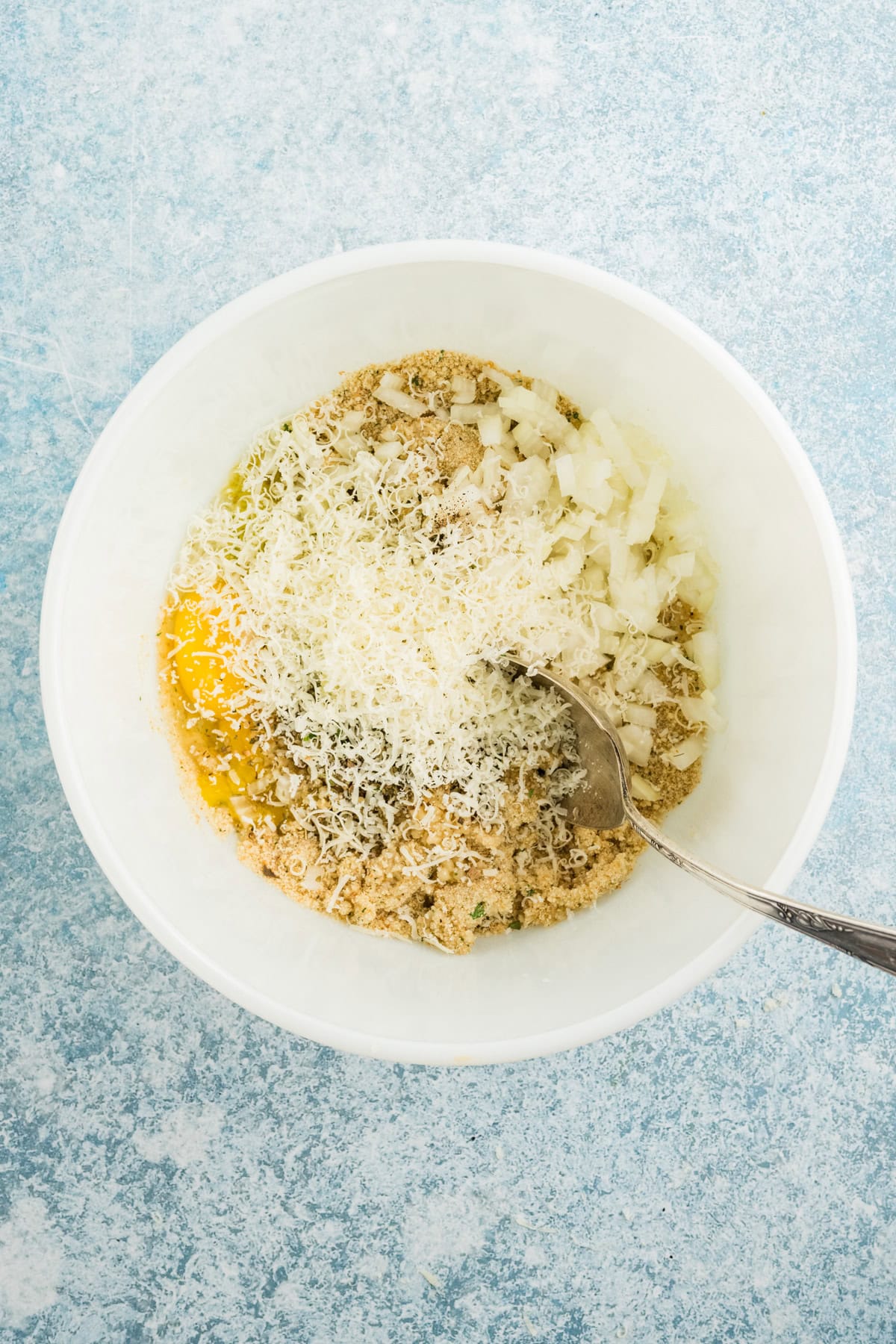
In a bowl, combine the breadcrumbs and milk. Allow this mixture to soak for a few minutes to moisten the breadcrumbs, then add the beaten egg, half of the parmesan cheese, the onion and garlic, most of the parsley, and the olive oil, Italian seasoning, salt, and pepper.

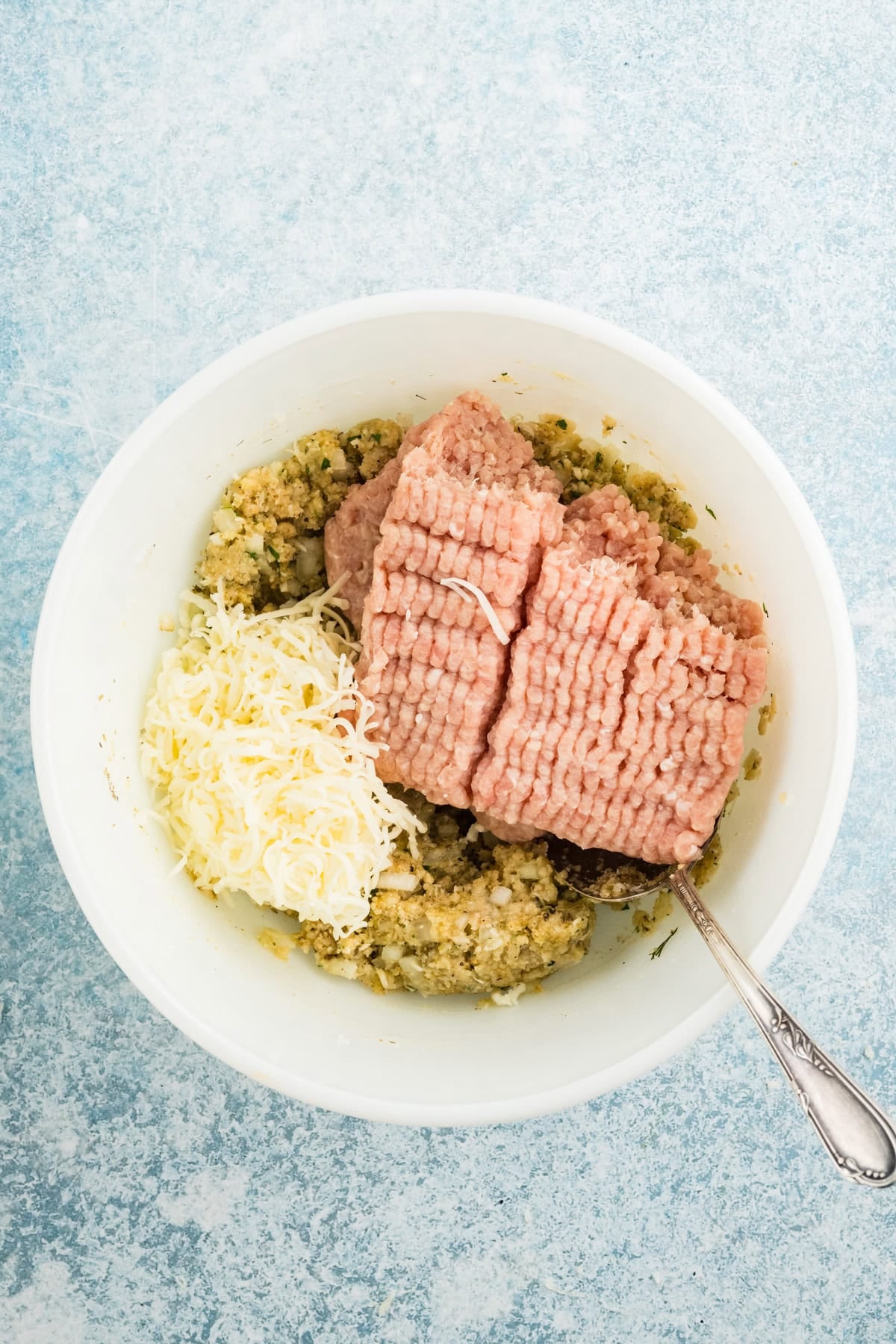
Mix the ingredients until well combined, then add the ground chicken and half of the mozzarella. Mix just until incorporated, being careful not to overwork the meat.

Transfer the mixture to a parchment-lined loaf pan. Bake at 375°F for 30 minutes.


Spread the marinara over the top of the meatloaf, then sprinkle on the rest of the cheeses. Bake for another 10-15 minutes, until the cheese is melted and the meatloaf is cooked through.
Tip! For crispy edges, use the parchment paper to remove the meatloaf from the pan and transfer it to a sheet tray before adding the topping and returning it to the oven.


Allow the meatloaf to rest for about 10 minutes before serving. Garnish with the remaining parsley and enjoy with additional warm marinara on the side.

If you’re meal prepping, you can assemble this parmesan chicken meatloaf up to 1 day ahead of time. Cover the pan tightly with plastic wrap or foil and refrigerate until you’re ready to eat, then cook the meatloaf according to the recipe directions.
Store leftovers in an airtight container in the fridge for up to 4 days or freeze for up to 3 months. If frozen, thaw overnight in the fridge before reheating.
If you’re reheating multiple portions, I recommend warming the meatloaf in the oven. Individual portions can be reheated in the microwave until warmed through and served as-is or turned into the most delicious meatloaf sandwiches.

If you don’t have a loaf pan, you can free-form the meatloaf mixture on a parchment-lined, rimmed baking sheet or even in a casserole dish. Free-forming the loaf will give you more crispy edges, making it even more delicious!
Yes! Use a non-dairy milk in place of the whole milk and use dairy-free cheeses.

If you love this parmesan chicken meatloaf, you may enjoy some of these other comfort-food dinners:
The post Parmesan Chicken Meatloaf appeared first on Fifteen Spatulas.
quoteoftheday_feedquoteoftheday_feedquoteoftheday_feedarablit_feed

The British Centre for Literary Translation (BCLT) Arabic Summer Workshop is now open for applications. These year’s workshops will feature twelve separate strands — including Arabic (led by Sawad Hussain, with participation by author Omaima Abdullah Al-Khamis), multilingual prose fiction (led by Michele Hutchison), and “training the trainer” (led by Daniel Hahn) — all of which will be held online.
While some of the programs will cost £375, the BCLT’s Arabic workshop series will be free for all ten chosen participants. The workshops are set to take place from Monday July 20 through Friday July 24 of this year.
For the Arabic workshop, there will be a focus on working with Omaima Al-Khamis’s novel The Al Musharaq Family’s Aunt, which was longlisted for the 2026 International Prize for Arabic Fiction.
Interested translators and aspiring translators can apply at the University of East Anglia website. The closing date for applications is Sunday March 15, 2026. According to organizers, all applicants who apply before the deadline will be notified of the success of their application by mid-April.
Another online summer translation workshop for Arabic-English translators is the Oxford Translates workshop, set for July 6-10 of this year. It will also be led by Sawad Hussain. According to Sawad, this workshop has a particularly robust focus on the literary industry that includes a reader’s report workshop with Elizabeth Briggs from Saqi as well as some pitching sessions to editors. There’s more information on the Oxford University website.
Editor’s note: We are planning to have fewer of these translator-specific updates on the website; if you’re interested, you can sign up for our occasional Opportunities for Arabic<–>English Translators email newsletter.
wikicommons_potd_feed| Picture of the day |
|---|
 |
Two Glanville fritillaries (Melitaea cinxia) on a red clover. Today is Kaede Hondo's birthday, she voiced Kokoro Yotsuba in Kamisama Minarai: Himitsu no Cocotama. |
quoteoftheday_feedquoteoftheday_feedquoteoftheday_feedquoteoftheday_feedarablit_feed

This poem, by award-winning author Bassma Sheikho, appears in our latest issue, SYRIA: Fall of Eternity, ed. Ghada Alatrash and Fadi Azzam.
By Bassma Sheikho
Translated by Maisaa Tanjour and Alice Holttum
2016
No electricity tonight.
Boredom is about to kill me.
Books are viscous, slipping from my hand.
The pens hate me—
I can feel it.
Everything in this house is screaming:
Get away from me!
My memories are worn out:
I’ve chewed them so long,
they’ve lost their taste.
And you—you’re a gray creature.
Your colors don’t excite me.
Neither your presence nor your absence tempts.
I amuse myself by counting the martyrs.
I start with the house,
the neighbourhood,
the city.
Damn these numbers—
I hate them:
they are too many.
Blood is pouring heavily from my mouth.
I stand before the mirror,
their faces jostling in front of me.
I reach out to shake their hands.
I’m ashamed of their blood on my face,
of my raw scowl
before the smile in their eyes.
I step quickly away
so that they cannot question me.
I am no good with answers,
nor am I a fan of speaking with the dead.
I climb to the roof.
A long breath—and I nearly swallow a few stars.
I scream:
Freedom
and tear through the maidenhead of the sky.
I tremble a little
then rise gracefully,
like a leaf in the mouth of the wind.
I feel that pleasure.
The walls of the buildings trap the echo,
let it throb between their ribs.
A light is born in the heart of a broken lamp,
like the call to fajr.
It smooths the wrinkles of the days,
awakens the city’s doves
to gift me a shawl of their white feathers.
And I enter my mirror,
radiant
like their bodies.
Artwork by Omran Younis.
Bassma Sheikho is a Syrian writer, poet, and visual artist, born in Damascus in 1986. She holds a Master’s degree in Interior Architecture from the Faculty of Fine Arts and previously taught at the Faculty of Fine Arts at Damascus University and at Arab International University. Her published works include the book Interior Design in Kindergartens and an upcoming book on the concept of beauty in visual art. She has also authored four poetry collections: Playing with Words (2013), A Gasp of Light (2015), The Last Inhabitants of Damascus (2016), and A Sea Afraid of Drowning (2018). Two additional poetry books are ready for publication. Many of Sheikho’s poems have been translated into English, French, Japanese, and German. In 2024, she published a short story collection for young readers titled The Man Who Vanished into the Sun, and she has a forthcoming short story collection for adults titled Typographical Error.
Maisaa Tanjour is a freelance translator, researcher, and interpreter with extensive experience working in diverse professional, humanitarian, and multicultural settings and organisations. Born in Syria in 1979, she now resides in the UK. Maisaa holds a BA in English Language and Literature and a Postgraduate Diploma in Literary Studies from the University of Homs. In 2005, she moved to the UK to pursue further postgraduate studies at the University of Leeds, where she earned an MA in Interpreting and Translation Studies (English-Arabic/Arabic-English) and a PhD in Translation Studies.
Alice Holttum is a part-time freelance translator and translation proofreader. She was born in Edinburgh in 1979 and currently resides there, working also as a furniture maker. She has a Joint Honours BA in Russian and Arabic (2004) and an MA in Applied Translation Studies (Arabic-English, 2006), both from the University of Leeds.
wikicommons_potd_feed| Picture of the day |
|---|
_22-03-2025_(d.j.b.)_01.jpg) |
Ground shoot of one Euphorbia griffithii Beautifully colored ground shoot emerges in a natural border. Focus stack of 15 photos. |
quoteoftheday_feedquoteoftheday_feedquoteoftheday_feedquoteoftheday_feedarablit_feed

Alexander Elinson in conversation with Tugrul Mende
In 2023 Saïd Khatibi won the 2023 Sheikh Zayed Book Award in the young author category. Did that have anything to do with your decision to translate the novel? What role do you think Arabic literary prizes play in the ecology and economy of literary translation?
Alexander Elinson: I honestly don’t remember how I first came to read and translate The End of the Sahara. Saïd and I were introduced to one another in early 2023 by Amara Lakhous, a mutual friend, whose opinions and recommendations on literature I take very seriously. It may have been following that introduction that I decided to take a look at The End of the Sahara. Of course, Saïd Khatibi was not completely unknown to me prior to 2023, his Firewood in Sarajevo having been shortlisted for the International Prize for Arabic Fiction in 2020.
To speak to your question about the Sheikh Zayed Award, though, I can honestly say that having won that award definitely pushed the novel up on my “to-read” list, and after reading just a few chapters, I knew it was something I wanted to work on. While the importance of literary prizes is not entirely unproblematic in the marketplace of publishing and translation, I do think it is undeniable that prizes allow works to travel far beyond local readerships and markets. That these prizes result in expanded readership in Arabic, and potentially translation into other languages for even more readers, is a positive thing. While I think I would have found my way to The End of the Sahara, prize or no prize, I can’t help but imagine that prizes provide an imprimatur for those outside the Arabic literary scene who might not be familiar with what is being written, published, and read in Arabic. The End of the Sahara is the first Arabic novel in translation Bitter Lemon Press is publishing. While I can offer a certain amount of experience and expertise with the proposals for translation and publication that I send out to publishers, I imagine that a work that has won a major literary award might stand out more than a cold call from some random Arabic translator living in Brooklyn!
Book awards and prizes and their selection processes can be influenced by economic, political, and personal factors. The value of these prizes both financially and in terms of exposure is significant, and the money and potential notoriety that stems from these prizes risk becoming goals in and of themselves. Nonetheless, I think the benefits of these prizes are substantial, raising the profile of writers both within the Arab world and encouraging works to be translated into other languages, thus allowing them to reach readers across the globe.
This novel—The End of the Sahara—is set in southern Algeria, during September and October 1988 and could be described as a detective novel. You’ve been drawn to detective novels in the past. What draws you to the genre? And what sort of detective novel interests you most?

AE: I love a good detective novel. Classic whodunit, police procedural, noir, hardboiled, I’ll read them all, as long as there’s a murder! What I love about novels that have a murder investigation at their center is that the crime of murder tends to pull back the curtain on so many secrets and taboos, be they personal, social, or political. A murder is so shocking, so surprising, so out of the ordinary. It shakes a community to its very core, and the ensuing investigation reveals secrets and truths that have often been concealed for decades behind carefully constructed narratives and defensive strategies. Under questioning, every character is at their most vulnerable, forced to account for everything they do, say, and feel. Murder and its investigation shatter people’s defenses, revealing secrets that may or may not have anything to do with the murder, but are illuminating nonetheless.
Do you read detective novels in your spare time? Are there other novels you thought about, during the translation process, while you were working on The End of the Sahara’s voice in translation?
AE: I do. Raymond Chandler, P.D. James, Agatha Christie, Dashiell Hammett, Leonardo Sciascia, Walter Mosely, Amara Lakhous, and others. I hear voices from all of these novelists when I read The End of the Sahara. From the opening sentences, we feel the noir-quality of The End of the Sahara. The languid rhythm. The gritty atmosphere. While the story is told by ten different narrators, each with their own distinct voice, the over-arching tone is dark. It is punchy and raw, full of wisecracks.
This story is told, in successive chapters, by a range of different characters. How did you manage to set different tones in the chapters for each character? At what stage of translation do you hone voice, and how does it work?
AE: I think about voice, and the diversity of the individual voices, quite early on. Of course, the original Arabic reflects the multiplicity of voices through a given character’s diction, vocabulary, cadence, rhythm, and more, so even with the first reading, I am aware of the different voices. I pay close attention to the ways characters speak and narrate, listening as much as I can to what they say and how they say it. Beyond that, it is so important to really understand the character, to form an image of how they dress, how they walk, stand, talk, argue, interact with others. All of these aspects of their character will help me bring their voice into English.

It is true that my first or second draft might be quite raw and literal, but as I edit and polish the characters’ voices emerge. After reading through the novel a number of times and combing through my English drafts, the characters come into sharp relief, speaking an English that best captures who they are: the college-educated videotape shop owner, the poor shepherd, the self-conscious lawyer, the police investigator, etc. In early drafts, I might start giving voice to the characters according to general stereotypes. After that, though, and especially in a novel that is so skillfully written and richly composed, the characters start to emerge as individuals with rich backstories and ways of acting and speaking that are unique to them.
Did you have a favorite character (or characters)? Any that particularly resonated with you? And do you think there are elements to these characters, and the way they interact, to which non-Algerian readers might not be privy?
AE: Although the novel takes place almost forty years ago in small city in the heart of Algeria, I have to say that the characters are entirely familiar and relatable outside of the Algerian context, which is one of the things I love so much about this novel and Saïd Khatibi’s writing. While the setting, history, and social and economic context of the novel are very specifically Algerian, the characters are familiar. We dislike them and we sympathize with them. We understand them and we reject them. Whether it’s Ibrahim, a college-educated underachiever who has dreams of success in the music business, Achour Hadeeri, a proud shepherd forced to leave his village for the larger city and live in poverty, Noura Arkoub, a struggling lawyer who strives to challenge her patriarchal surroundings and forge her own way, or her brother, Faudel, engaging in petty crimes and brawling around the neighborhood with his gang of fellow toughs, we know these characters. We grew up with them. We went to school with them. We worked with them. We got beat up by them. For better or worse, these are people shaped by pressures we can all relate to.
I don’t think I can say who my favorite character is. There are characters I can imagine getting along with more than others, but I don’t think that’s what your question is getting at. There is no character whom I feel I know better than the others, at least among the principal leads (the narrators). But even the supporting characters come with vivid and believable backstories that make them plausible, human, sometimes contradictory, but mostly sympathetic.
The novel is set in 1980s Algeria, and in a city where you have (probably) never been. What kind of research did you do in order to get a handle on the setting and the events of that period?
AE: I have never been to Algeria although after spending so much time with The End of the Sahara (and Amara Lakhous’s The Fertility of Evil, which I have also recently translated) I would love to go and be able to add real images to the imagined ones I have constructed in my head! I have been teaching about Algeria, the Algerian Revolution, the political and economic crises of the 1980s, and the black decade of the 1990s for years, so I came to this project with a good deal of familiarity with the general history of Algeria during this time. The novel takes place over the course of a period of weeks leading up to the October 5 riots of 1988 in a small unnamed city on the edge of the desert. While the city resembles Bou Saada, the author’s hometown, it is meant to represent any small city the lies on the margins of society. A city far from the center of things, from grand historical narratives. The draw of this novel is that, while the larger historical context is important, what the reader sees is how that context is lived and experienced on the ground, by real people. With the drop in oil prices in the 1980s, the Algerian economy suffered. We understand this suffering through Ibrahim’s sketchy and shoestring VHS cassette rental business, Faudel’s petty criminality and hustle, Achour’s hardscrabble life in his village, and later in the meadow slum where Zakia Zaghouani—who ran away from home to try to make a life for herself—met her death. History is important in understanding the context of the novel, but that history is incomplete without understanding its real-life effects.
Can you tell us a bit about your relationship with Said Khatibi as it unfolded during the translation process? How did you work together (or not work together) on the novel?
AE: Although we have not met in person (yet!), we have developed a strong working relationship and friendship. While working on this translation, we were in constant contact. He read and commented on drafts, and he provided guidance with certain aspects of Algerian Arabic, specific terminology for objects and concepts that I might not be familiar with, historical references, and more. Beyond that, Saïd is a very close and careful reader, and he often challenged me to find just the right way of saying something in English. We might debate a word or a phrase for days over email and Zoom! I often took his advice and suggestions, but even when I didn’t, the translation ended up stronger for the open discussions we would have. It is a very collaborative process.
And . . . what are you working on next?
AE: Let’s just say that I’m working with some familiar friends.
Tugrul Mende is a regular contributor at ArabLit.
arablit_feed

This essay, by the extraordinary Syrian writer Samar Yazbek, appears in our latest issue, SYRIA: Fall of Eternity, ed. Ghada Alatrash and Fadi Azzam.
By Samar Yazbek
Translated by Maisaa Tanjour and Alice Holttum
After the Fall
They are the beggars of Damascus—its children, its teenagers, scattered in every corner of the city. They don’t hesitate to grab your clothes, admonishing you to give them something to satisfy their hunger. Those who smear their small bare feet with frozen mud in the bitter cold of February just to make their misery clear, those in the alleys of Old Damascus; they won’t eat you, and their filth won’t stain your clean clothes. They are the silent night-dwellers who cry out during the day. Stubbornly, I tried to understand their movements, their actions; they became my obsession for days, to the point that they themselves began to wonder: Who is this “clingy aunt”? Who is this parasite who wants to turn our tragedy into a spectacle? Perhaps this is what we all do—those of us who write about the suffering of others without the ability to save them. It is yet another disgrace added to the shame of humanity.
At night, human voices emerge which are different from those we hear in the full blaze of day. Their owners don’t seem to be searching for anything specific; rather, they’re possessed by anger and emptiness. Many emotions flicker in their eyes, but two are most prominent: numbness and rage. The usual begging and pleading appear like a thin crust, one that a true human being, an observer, can break through. Even a monstrous novelist might shed a few tears at the sight of those imploring and deceptive looks. Yes, there is emptiness and rage—but, my dear, you have neither the time nor the energy to figure out each and every look on its own. And don’t be fooled: when we speak of the “silent night people” of Damascus, we don’t mean they’re a homogenous group, one that can be analyzed, understood, or classified. That is a pitiful, outdated notion. No group can be measured by fixed standards—especially in a place like Syria, a land that has grown so terrifying it defies belief. The silent night people are the very same ones who, by daylight, scream and run and shout. But night strips them of their voices, save for those who linger, growling, swearing, and cursing, eyes burning with hatred and anger, until exhaustion drags them into sleep. These are people ready to tear down the whole world. And one day, they’ll swarm like locusts to devour it.

Let us agree: this isn’t a story about the street children of Damascus, but an attempt to write against forgetting, against simplification, against the official narrative of childhood. War doesn’t just give birth to orphans; it births a whole new concept of childhood—a childhood with torn shoes, treading over the city’s body as if walking on its skulls. It is about misery stripped of any human feature. This is a text about voices that do not scream, about looks that dismember the city more than the shells ever did. Don’t be terrified. Don’t be afraid as you read these words.
Because I was living in Old Damascus, specifically in the Qaymariyah neighborhood, I had observed three groups of “silent night people.” One stood in Bab Touma Square, and the other two appeared just beyond the square after the first left turn. They were not fixed groups—sometimes individuals appeared alone, sometimes their composition changed—but the Qaymariyah group held the most prominent place in my mind. It consisted of three girls: one barely over three years old, silent and old for her age; the second about seven; and the third approaching adolescence—she said she was thirteen. She was the only one who agreed to give me a name, which I later learned was not real.
On my way to see them every night, there was an old woman who wouldn’t stop talking and begging, alone in her wheelchair. She sat in the alley, repeating her pleas, receiving money from passersby. Around her, boys with sharp tongues moved about, swearing at her, disappearing, then returning. I watched her from afar, trembling at her shivering cold. After she collected her money, a young man appeared; he approached her and snatched what was in her hand. She cursed him and prayed for his death, and he fled while the boys flocked around him. This scene was repeated with precise regularity. Everyone knew their role. The young man’s eyes were wide, watching the old woman like prey. He lunged, then ran away. She howled, then fell silent, then resumed her begging.
I was told that entire groups operated by putting old women and children out to work. This old woman wasn’t playing a role, she was truly disabled. Her face, pale under the yellow streetlight, contorted as she screamed and cursed at the boys, who pinched her, shouted in her face, or tried to snatch a loaf of bread from her hands. At some point, the boys would leave and the young man would walk away. He’d disappear; I could see no sign of him. Then, after midnight, she would fall completely silent… and then he would return. It must have been him, sometime around dawn; the same young man would come and take her off somewhere. In the morning, she’d be gone, but by early afternoon, she would always be back, placed in the same corner, in the same state, as though nothing had happened. She never responded when I spoke to her. Yet despite her disability, she remained a serious competitor to the nearby group.

As for the three girls, they were alone, apart from a boy who refused to tell me his age and looked astonished that I’d even asked. He simply repeated a single phrase: “I want to eat, Auntie.” You, dear reader, could offer him a sandwich and he’d take it. But he would also curse you, because it wasn’t the money he needed. The young man who took money from the old woman also demanded it from the boy, and if he didn’t get it, he’d beat him. Once, he struck him—slammed his head against the wall—right in front of some passersby, who kept walking as though nothing had happened. A brief glance at the boy’s bleeding head, and they moved on. For a moment, you feel like nothing moves forwards in this city, but rather slips backwards, to a time before speech, when everything was understood through crying.
In Bab Touma, the nocturnal crowds never stop. The streets are packed, and on every corner, a child extends a hand and asks, as if the question of need has become part of the street’s architecture, carved into stone like Sumerian inscriptions. The food shops overflow with customers and child beggars sprout there like grass: tender grass, dry grass, grass trampled underfoot or glanced at indifferently, then left behind.
I decided to come after midnight, to stay and wait, to find out when they would leave.
It was a night in late February of last year.
In other parts of Syria, people don’t venture out after five in the afternoon—I saw this in Latakia and Jableh. But Damascus is different. Syrians argue endlessly over whose version of events is true. Each has their reasons. Each belongs to a different “Syria.” What is said in Damascus isn’t a lie, and what is said on the coast isn’t a lie. They quarrel over right and wrong, while each carries their own share of truth, their own portion of sorrow, and their own burden of shame. But in the narrow alleys of Bab Touma, life carried on with the “night people” in a different way.
I was standing in the corner, watching the three girls. My eyes were on the little one—barefoot, barelegged, wearing a dress that reached her knees and a pair of shorts underneath. Her feet were caked in dark mud, as if someone had smeared them with a thick paste. The same mud clung to her hands and face. The small, skinny feet and the dust-streaked face made her look like a creature that had just stepped out of a film, not out of an alley. She sat on the rain-soaked ground. Her dress was damp. What color was it? No color. Maybe it had been white once. She looked only at the feet of the passersby, her eyes always fixed at the level of their steps, her hands stretched out without a word, without a gesture. If you came near, she flinched.
By day, there was another girl, the one on the verge of adolescence. Black, sharp eyes, her hair tied in a ponytail. Barefoot too, though not smeared in mud like the little one. Her hair was thin, matted. She wore a loose-sleeved dress over long trousers. She was the one in charge. She spoke, begged, pleaded, got angry, knocked on the doors of the world with her voice. Sometimes quiet, sometimes firm, sometimes screaming, howling. The little girl—three years old, or a little more, or a little less—would call out “Uncle” and “Auntie” during the day, while at night, her gaze would drop to where the feet moved. Some passersby, when touched by a moment of guilt or sorrow or anger, or a fleeting mercy, would give them money. Others avoided them.
One day, Suaad—that was the name the dark-eyed girl gave me after a long negotiation in exchange for money—grabbed the skirt of a woman passing by. Suaad told me that was her name, then gave me a different one on another day. Every piece of information had a price, and she knew that perfectly well. Clever, trained, and fully aware of the rules of the game. When Suaad tugged at the woman’s skirt, the woman slapped her, screamed, and ran off, shouting behind her, “Thief! Thief!” Suaad didn’t stay silent. She shouted back, “Liar!” then hurled a heavy insult, spat on the ground, and barked at the two girls who were with her to follow. But she had already let go of the little girl’s hand. The terrified child started running after her, alone.
If you wanted to sit in Bab Touma Square, there were still some benches left from a small park that had long since ceased to be a park. I sat down with Suaad. She agreed to sit and talk, but started off firmly: “I don’t want to say anything. And if you can help me, then do it and leave.”
“Where are your parents?” I asked her.
“Dead,” she replied curtly.
I asked about the two girls—were they her sisters?
“No.”
“Then whose daughters are they?”
She gave me this sarcastic look, as if to say, Are you stupid?
At that moment, she looked as though she were thirty, even though her features still belonged to a teenager. Strong, confident, unyielding. I thought she must be harassed often—she was beautiful—but the filth covering her face cut that thought short. That filth seemed like part of the uniform, a daily necessity.
“I can help you,” I told her plainly. “Where do you sleep?”
She pointed to the street. “In the street,” she said. Then she added, “If you want to help me, give me some money.”
“Don’t you want a place to sleep?” I said.
She gave me that awful look again then ran off. All the information I’d gathered over the past days confirmed that the ones exploiting these children were gangs spread out across Damascus.

Suaad was certainly born at the beginning of the revolution. She knew nothing of the Syria we once knew. She had spent most of her childhood on the street. A strong girl. Tough. Ready to devour you. She defended the two girls fiercely, though she never admitted they were her sisters. Maybe they were not—though I had a hunch they were. At night, Suaad would fall silent. The two girls would fall silent. And the boy who was always with them would fall silent, too. After ten o’clock at night, I would pace back and forth in front of them, telling her, “I live here. If you need anything, I’m here.” She’d ignore me completely. I would stand in a distant corner, where the dim streetlight didn’t reach me, and watch the three girls and the boy. I heard her call him “Muhammad.” The little one could barely walk. She would sit on the ground, stretching her legs out into the path of passersby. If someone wasn’t paying attention and stepped on her foot, she’d scream. Startled, they’d turn back and give her money. A clear, deliberate tactic. She’d take the money, hide it in her tiny hand, clutching it tight. After a while, she’d stretch out her hand towards Suaad and hand it over. Suaad would tuck it into her pocket. Then, the money would pass to Muhammad’s hand. I had no idea where Muhammad went after that. He would disappear for hours, then come back. Suaad walked like a man. When you’re a girl sleeping on the streets, you have to learn to walk like you fear no one. She moved like the leader of a small gang.
She looked around her with confidence—never begging, never degrading herself. She must have been harassed, maybe worse. Beautiful, homeless, young. Surely many had told her, “Come with us.”
I kept thinking about it—probably too much.
The day after she had run away from me in Bab Touma Square, I told her I could connect her with organisations that could help her and her “sisters.”
“They’re not my sisters,” she said scornfully, then added, “Give me money for a sandwich.” She jerked her head derisively and walked ahead of me with a theatrical, sarcastic strut, her eyes gleaming with contempt for the world, as though it were about to explode from within her. Her thin, matted hair looked as if it might catch fire at any moment. All the mockery, the hate, the shame a single eye could carry, I saw in hers. And she had every right. Every right to look at me—to look at the world—like that.
She placed one hand on her hip, stood with her feet slightly apart as gang leaders do, raised her head to the sky, and pointed to Muhammad, who was standing a little way off—always in the same spot, as if drawn there in ink.
He started walking towards her, and I turned my back and withdrew into the daytime city. As midnight neared, fatigue began to settle over the girls’ faces. They lay down on the ground, barefoot, each one stretching her mud-caked feet halfway into the alley.
Anyone passing by had to sidestep them, adjust their stride, acknowledge their presence—if only for a brief moment. There they layed, weary, drained, silent. The boy came and went, disappeared, then came back. I followed him once. He moved down another alley towards a different boy standing off at a distance—a small, wiry kid, thin but full of life. It looked as if the two of them were carrying out a task.
Not far from them, another group I hadn’t seen before: two girls, probably around nine or ten years old, with a toddler no older than two, barely able to stand. She looked exhausted, filthy, tottering. The groups were scattered, each occupying its own patch. Boys moved between them, stringing them together, like go-betweens. Other boys moved alone, darting around lightly—begging, shouting, swearing.
One boy, maybe seven years old, when I didn’t look his way and kept walking, cursed at me, then darted away. They do that, sprouting up everywhere. Maybe here, in Bab Touma Square and the Old City, they know there’s a high number of visitors and strangers, so they gather in large numbers. It is their chance to scrape together a little, to stay active, their movements managed by whoever has assigned them to the alleyways.
I remembered the woman who shouted “Thief!” at Suaad, then urged the gathered crowd to “catch that homeless animal,” as she put it. She was characterising these kids as a bigger threat than any of the dangers surrounding the people of Damascus. When I stepped towards her and said, “She’s just a child,” she snapped back, “They’d kill for a thousand lira! I live here. I know what they do. They’re an organized network. These aren’t children—they’re criminals.” Then she shot me a look of heavy disdain and superiority, and flicked at her skirt as if dusting herself off—or perhaps shaking the guilt off her soul—granting herself, and only herself, the privilege of survival.

No one can say for certain where all these displaced people came from. But it’s a long war. At night, they transform into silent creatures—perhaps from exhaustion, or maybe because their daytime work bears its fruit at night, through this silence… and the display of bodies. Muddy, waxen bodies. I watch them closely, under a sky that bears witness to human cruelty and depravity. Bodies lying everywhere, becoming part of the ordinary everyday scene, part of the portrait of the new Damascus—the post-war Damascus. Anyone who sees the devastation surrounding Damascus, its countryside, and its towns might guess where these children came from. I met a young woman who works for one of the civil society organisations. She insisted on hiding her identity and the name of the organisation. She said some of the children come from the north, and not all of them are necessarily war orphans.
She said that some children are sent by their families to the streets to beg for food or whatever they can manage. I asked her, “Are there many families who send their children off?” “Yes, there are many,” she replied. “And there are young girls who are subjected to harassment. I have three cases of child rape.”
“Children, boys and girls, appear suddenly, then just as suddenly disappear. No one knows what happens to them.”
When I began researching the lives of these nocturnal wanderers who sleep on the streets and walk among us, I did not intend to consult statistics or knock on the doors of children’s rights organisations. My only concern was to follow the personal lives of the three girls. They were silent. Only Suaad, the eldest, was allowed to speak.
On the sixth day, at eleven o’clock at night, the girls were lying in the street—small, exhausted bodies, muddy feet, hands outstretched, waiting for a coin from a passerby moved by conscience or a fleeting moment of pity. Suaad paced back and forth to each end of the alley like someone reviewing their position on a battlefield. The city at that moment was breathing slowly. The young men of Hay’at Tahrir al-Sham moved among the people, watching them unblinkingly; the people looked back, some with curiosity, others with suspicion or indifference. Groups crossed paths and ignored one another, and some hurried by, as though to escape the possibility of meeting an eye that might indict them for their silence.
I approached Suaad again; this time, I tried to be clearer. I told her I was a writer and journalist, and that I wanted to help her. She looked at me with disgust and asked, “How much will you give me for what I say?” It wasn’t an innocent question, but a confirmation of the power dynamic she’d established from the very first moment. With every attempt, I repeated, “I want to help you,” making phone calls in front of her to convince her. But each time, she would dismiss me, mock me, or demand money for nothing in return. When I suggested that we take care of the littlest girl, Suaad laughed and said with biting sarcasm, “What little girl? No one here is little.” Her voice was sharp, as if she were spitting everything out at once. But for the first time since I’d met her, I saw something stir in her eyes—a flicker of water, a thread of a tear, something glistening about to drop, then gathering itself back. In a weary, defeated tone, she said, “Let us make a living and leave us be.” Then she went back and sat down beside the two girls and gathered them into her arms, as though the whole world rested in that embrace.
Their muddy legs gleamed under the cold streetlight like weathered wooden sticks. When I tried to approach again, she screamed, “What’s it got to do with you?” She stretched out her hand then hurled a heavy insult at me before walking away. I couldn’t reply. I stepped back, feeling that I had lost the ability to break through this wall. I was certain someone would soon come to take them off somewhere, letting them loose again in the morning.
The hour had passed midnight. Suaad was holding the little girl in her arms, her eyes shut from exhaustion. The number of passersby had begun to dwindle. A pair of lovers walked past—not touching, but their eyes revealed that scandalous, unspoken look. The young woman paused for a moment, looked at the three girls, pressed a hand to her mouth, and closed her eyes. She was thin, wearing tight jeans, and it looked like she’d been crying. The young man beside her pulled out some money and held it out to the girls. The scene was harrowing—especially that little girl, barely three years old, if not younger. She looked closer to two, frail and pale as though suffering from anaemia, her tiny body hardly able to endure the cold. Nearly naked, barefoot, lying on the ground like a discarded stone in a forgotten alley. The next day, the neighboring shopkeeper would tell me, “These are the necessities of the job, madam.” He said it as though offering a simple explanation for a painfully complex scene. By one in the morning, I couldn’t bear it any more. I was shivering from the cold, circling around them, not knowing what awaited me—or them. I left, carrying with me a terrible, hollow emptiness.

At four-thirty in the morning I woke up terrified. I had barely slept three hours and I knew I wouldn’t be able to close my eyes again unless I saw them—unless I made sure they were still there, in their usual corner of the alley. I left the house a little before dawn, running through the alleys damp with Damascus’s gentle rain, wondering what I would find. When I arrived, the scene was exactly as I’d left it: the three girls lay asleep, as if they’d turned into creatures of clay and light, wrapped in a thin, grey blanket that barely covered half their bodies. Suaad held the little three-year-old in her arms, while the third girl clutched her hand and rested her head on Suaad’s shoulder. Muhammad, the boy who drifted in and out of the night like a shadow, was asleep in the far corner, covered with a different blanket. The fine rain fell onto their heads. The ground was wet, the air cold and the sky heavy. And yet, no one moved. Only their cheeks, catching the misty drizzle, and their noses, barely visible under the blanket. Suaad’s lips had turned blue from the cold, her face frozen like a stone. The little one slept deeply, mucus running quietly from her nose as though she’d grown used to sleeping this way. The middle girl was frighteningly beautiful—a fragile beauty pleading for salvation. I approached slowly, careful not to wake them, not to startle them. Still, Suaad opened her eyes. She didn’t move. She just looked at me—that same mocking, deep gaze, sharp as a blade. Then she blinked. She didn’t say a word. Didn’t so much as twitch a muscle. But that look was enough. It was everything that could be said. A whole language without letters. I wanted to hear something from her. Anything. A sentence to break the silence. One story. But she wouldn’t; she wouldn’t tell me where she came from, or who the little girl was, or who Muhammad was. She left me there, hanging in limbo—like the thousands of Syrians who pass by these children every day and return to their homes burdened with emptiness and unanswered questions. For a moment, the thought crossed my mind to sit beside them. To be like one of those kind grandmothers in the old tales. To tell them a story. To pull the blanket up around them. To buy them a warm breakfast. They could have been my granddaughters. But instead, I left them. And I walked through the streets of Old Damascus—those alleys that were once a refuge for lovers and memories, now a refuge for rage, for displacement, for unknown fates.
The rain, which I had once thought of as celebratory after years of exile, now felt like lashes. It didn’t caress my face—it whipped it. I walked away, feeling the weight of betrayal pressing down heavily on my back. Betraying them, especially Suaad, who was there, despite everything, guarding the two little girls like a wounded lioness. Maybe they were nothing more than tools in some organized child exploitation network. Maybe they truly were sisters. Maybe Muhammad was their brother. Or maybe none of them had known the others, and life had simply thrown them together, just like that, on the pavement, in this defeated time.
But the only certain thing was that Suaad—that young girl with the dead eyes—stood like a solid wall between the two others. She was protecting them with all her rage and silence. And in that last glance she had given me, she was saying: “Come closer and I’ll kill you all.”
In the end, this isn’t a report. It’s nothing but scattered writing—against documentation, against archiving, against reducing childhood to numbers and statistics.
Just words.
Words that walk barefoot with Suaad and sit beside her in silence under a rain that won’t stop.
I wish I had told her, “I’m sorry. Just… sorry.”
Artwork by Etab Hreib.
Samar Yazbek is a Syrian writer, novelist, and journalist. She was born in Jableh in 1970 and studied literature before beginning her career as a journalist and a scriptwriter for Syrian television and film. Her novel Planet of Clay, also published by World Editions, was a finalist for the National Book Award and longlisted for the Warwick Women in Translation Prize. Her accounts of the Syrian conflict include A Woman in the Crossfire: Diaries of the Syrian Revolution and The Crossing: My Journey to the Shattered Heart of Syria. Yazbek has published two collections of short stories, seven novels, and four non-fiction literary narratives. Her books have been translated into multiple languages and recognized with numerous awards—notably, the French Best Foreign Book Award and the PEN-Oxfam Novib, PEN Tucholsky, and PEN Pinter awards. She was recently selected to be part of the International Writers Program with the Royal Society of Literature. Her latest novel, Where the Wind Calls Home, is shortlisted for the National Book Award 2024.
Maisaa Tanjour is a freelance translator, researcher, and interpreter with extensive experience working in diverse professional, humanitarian, and multicultural settings and organisations. Born in Syria in 1979, she now resides in the UK. Maisaa holds a BA in English Language and Literature and a Postgraduate Diploma in Literary Studies from the University of Homs. In 2005, she moved to the UK to pursue further postgraduate studies at the University of Leeds, where she earned an MA in Interpreting and Translation Studies (English-Arabic/Arabic-English) and a PhD in Translation Studies.
Alice Holttum is a part-time freelance translator and translation proofreader. She was born in Edinburgh in 1979 and currently resides there, working also as a furniture maker. She has a Joint Honours BA in Russian and Arabic (2004) and an MA in Applied Translation Studies (Arabic-English, 2006), both from the University of Leeds.
quoteoftheday_feedquoteoftheday_feedquoteoftheday_feedquoteoftheday_feedwikicommons_potd_feed| Picture of the day |
|---|
 |
Doll (musha-ningyo) featuring Takenouchi no Sukune, minister of Emperor Ōjin; end of the Edo period, 19th century, Japan. Ann and Gabriel Barbier-Mueller Museum, Dallas (Texas) ; the photograph was taken during an exhibition in the Musée des Arts Premiers in Paris |
quoteoftheday_feedquoteoftheday_feedquoteoftheday_feedquoteoftheday_feedarablit_feed

Translation by Invisible Dragoman.
5.
The Blue Bead and Jubineh’s Return
On Mondays this winter, we are publishing installments of Emile Habiby’s The Six-Day Sextet, which is available in an open-access, non-commercial translation by Invisible Dragoman. You can find part one, part two, part three, and part four in our fiction section.
O Dweller of heavens Look down from on high
Keep your eye on us And on our lands
Bring our brothers and sisters and families back to us
We have houses and roofs And rooms upon rooms on high
Whose doors are open To the sun and Freedom
O Dweller above Look down from on high
Let doves fly To span the days
Give us rest In the hands of peace
—a song sung by Fairuz
One evening the young men returned from their usual outing. Darkness was falling as our car came upon the bonfires of our Galilean village. The smell of charcoal fires filled the air. Our guest cried out, “We’re here.” I honked the horn at these young men to warn them, not that they needed to be warned. In reality, I was honking to announce the arrival of our guest.
Here she is, returning to her village and to her elderly, disabled mother after an absence of more than twenty years. She had gone off with her husband and children to Lebanon. Now here she is returning, twenty years later, by way of the bridge over the holy Jordan River, carrying a two-week permit to visit her mother’s house.
She asks, “Is the spring still there?”
“It is still there—at the other end of the village. But it’s dried up!”
She laughed shyly, in a way you could hear but not see. “Jubineh has returned!”
Now it was my turn to laugh, but I could not do it.
Do you know the “Tale of Jubineh”? Or has it been buried in the ruins of al-Damun and Iqrit? It’s the story of a barren woman who used to make cheese in the village. She would pray to God, asking Him, the Dweller of heavens, to give her a daughter with a face as fair and round as the cheese in her hands. He did give her the likes of a girl who could say to the moon, “Sit down and let me take your place.”
Hugo named his heroine Esmeralda. But the village woman named hers Jubineh. She brought her up, pampering her, dressing her in embroidered silk, and tying a blue bead around her wrist. When Jubineh walked, her thick ankle bracelets rang like a sweet song, alerting the calves to her approach so that they could make way for her.
Then, to make a long story short, she, like Esmeralda, was kidnapped by gypsies. Her mother searched and searched for her, all the while lamenting her loss, until, finally, she collapsed and the light went out of her eyes. As for Jubineh, she was passed from one master to another until she wound up tending geese in the fields of a prince in a far away town. Seven seas and seven years now separated her from her mother and father.
As she drove the geese in front of her, she would sing in a sad voice,
O birds that fly
In the mountains high
Tell Mama and Papa
That Dear Jubineh
Now tends geese
And walks on thorns
In the mountains high
And weeps and weeps
Now, without going into too much detail, one day, the young prince heard her singing and was smitten by it. The next day, he returned there and fell head over heals in his heart. For seven days, he kept going back there, deeply in love and unable to sleep. After for seven long nights, he told his mother about it at which point Jubineh moved—as wife and princess—from field to palace.
A year passed. Princess Jubineh gave birth to a son, a youth as strong as a young bull. Another year went by and one day Princess Jubineh told her husband, “The country misses its people.”
He set her on a howdah full of perfumes, silks and gifts. When they got to the village, and the village’s spring, her child became thirsty. She watched as the women of the village argued with one another around the spring. She asked for water for her thirsty son.
One of the women answered, “There is no water in the spring. The spring went dry the the day Jubineh disappeared!”
Jubineh replied, “Go back to it and you shall find water in the spring.”
And so it was.
Now liberated, water began to gush from the depths of the broken-hearted land.
One of the women whispered to her sister, “Jubineh has returned!”
The news spread. Girls and boys ran through the village shouting, “Jubineh has returned!”
One boy rushed to Jubineh’s mother who was blind and invalid, as if she were under attack on all sides, which she was.
“Grandmother, Grandmother,” the boy shouted so she would hear him. Then gasping, eager to convince her, he said, “Jubineh’s back!”
But she did not believe him.
Disappointed, the boy returned to Jubineh’s howdah. Jubineh gave him the blue bead that she wore on her small wrist and said, “Tell Jubineh’s mother that this is from her.”
The boy placed it in the mother’s hands. She put it to her nose, inhaled and then wiped her eyes as tears gushed forth. The light had returned to them.
At last, they were reunited.
*
I said to our guest: “Our mechanical howdah is now entering the village. Will water gush forth from the spring?”
Our guest gave a smile you could neither hear nor see. As we were entering the alleys of the village, I asked her to guide me to her mother’s house, if she could still remember the way. She did.
I drove up a narrow alley as she continued to guide our way. All of a sudden she shocked me when she said, “Beware of the hole on your left at the next alley.”
The hole was there, in the exact place where Jubineh thought it would be.
Noticing my surprise, Jubineh said, “No, not everything has remained the same. We’re old now and so are the years gone by, and the valley and the hills are filled with children who I do not know and who don’t know me. But I bet they know that my disabled mother has a girl who lives abroad.”
This was also true. We arrived in front of a shop under which was her mother’s house. A young man was closing up the shop and noticed the car of strangers delivering an unfamiliar woman wearing modern, city clothes, at such a late hour. He rushed towards us, and without me saying a word of who this woman was, he started to turn and call out to the neighbors: “Her daughter is back! Her daughter has returned!”
The women neighbors ran out to receive her. I saw the crippled old woman at the bottom of the stairs stand up on her own two feet. She was trying to hear, trying to see, and trying to understand. They were saying, “This is your mother.” It was pitch dark and men were shouting to their wives to bring out the gas lamps.
The old woman standing on her feet at the bottom of the stairs was smiling in a way I have never seen in my life. It was like the traces of a wave on a sandy beach when the tide goes out. Through the clamor, joyful trills and wedding cries could be heard, bringing everything to a halt, silencing every other sound.
The old woman was the one singing these joyful cries. We could not understand anything of the verses she sang. Perhaps the only part of her singing we heard was the rustling of her lips. But I saw on her lips the veil of the bride drawing back.
At last, they were reunited.
*
As we were helping the old mother get back into bed, she pushed us aside and sprang as a lioness towards an old wooden box. She opened the cover and rifled through its contents, and then brought out old clothes that belonged to a seven- or eight-year-old girl.
Her voice was hoarse as she whispered, “These are your clothes. I saved them for your daughter. Why didn’t you bring her with you?” Then she took out a blue bead on a gold necklace and said, “Your father, God rest his soul, always said if you’d held onto this bead, what happened would not have happened. Put it on and never take it off.”
Our guest has come back to her mother. When I said goodbye to her, she told me with some embarrassment, “The new Jubineh—she’s not the one who kept her blue bead.”
I replied, “The water spring is on the other side of the village. It’s on my way and I’ll be passing by it. Maybe water is gushing out of it now?”
When I went by the water spring, I saluted. No one saw me do it. What’s wrong if I salute the spring? As for stopping at the spring, and as for seeing whether life has returned to it or not, I decided to postpone those things for another day.
Part one: Masoud’s Cousin Makes Him Happy
Part two: At Last, the Almond Trees Blossom
An uncopyrighted translation of Emile Habiby’s Sudasiyyat al-ayyam al-sitta, originally published in Al-Jadid (Issues 4-9), 1968. This is an open-access, non-commercial translation by Invisible Dragoman.
Translators’ note:
This translation of Emile Habiby’s The Six-Day Sextet came about in the following way. In a 2017 seminar on Arabic novels, I had the pleasure of teaching a small group of talented students: Kevin Chao, Fouad Saleh, Molly Simio, Andrew Slater, and Uma Mencia Uranga. As a collective final project, each student chose one chapter from this work to translate. I took one for myself. We edited each other’s work for accuracy and style and I edited them again for continuity.
After securing translation rights from Habiby’s estate, we submitted this manuscript to various publishers. Initially, there was some interest but after months of conversation, nothing came of it.
Covid arrived and years passed. As our translation of this remarkable text gathered digital dust on a hard-drive, we learned that there were disputes concerning Habiby’s estate and that the permission we’d been granted was itself likely disputed.
As we faced the likelihood that our work would never be published, we decided to share it in a non-commercial form. Given the author’s political commitments, we imagine that he might approve of our decision, but God knows best.
The striking images, composed by Habiby’s artist friend, Abed Abdi, first appeared in the first Haifa edition: Sudasiyyat al-ayyam al-sitta wa-qisas ukhra Haifa: Matba‘at al-Ittihad al-Ta‘awuniyya, 1970). They are copyrighted and used with the artist’s permission.
This translation is open access. Please feel free to read, store, and distribute for your personal, non-commercial use.
![[personal profile]](https://www.dreamwidth.org/img/silk/identity/user.png) timeasmymeasure
timeasmymeasure![[community profile]](https://www.dreamwidth.org/img/silk/identity/community.png) flatlanders
flatlanders

